Entry-Level Nurse Anesthetist Salary in Farmington Hills, MI: $162,503 (2026)
Quick Answer:New nurse anesthetists entering the Farmington Hills, MI job market in 2026 can expect a starting salary around $162,503 (BLS 10th-percentile benchmark for SOC 29-1151, projected from 2025 OEWS data). Stripping out Farmington Hills's local price level (BEA RPP 93.2 — 7% below national), a first-year paycheck buys what $174,359 would in average-cost America. Most reach the city median ($256,216) within a few years of clinical practice.
Based on BLS state-level estimates · View source
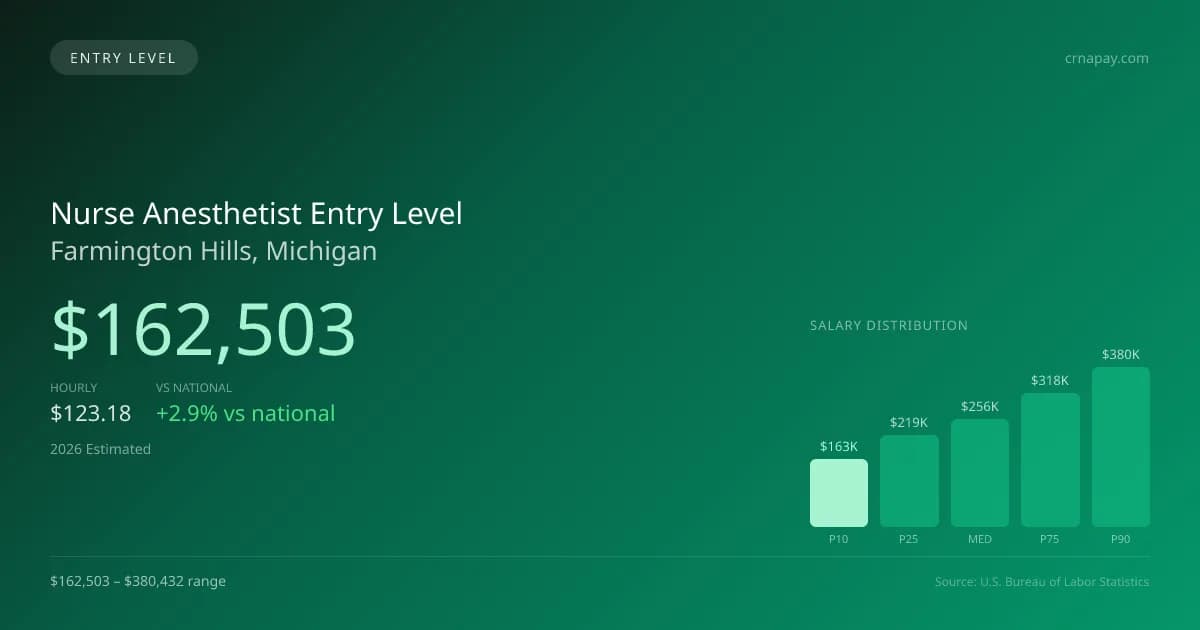
New graduates stepping into the role of a nurse anesthetist in Farmington Hills, Michigan, can expect a starting nurse anesthetist salary of around $162,503 in 2026. While this figure may initially seem modest compared to the area’s median annual salary of $256,216, newly minted CRNAs should recognize the potential for significant salary growth as they gain experience. Entry-level professionals can anticipate a gradual increase within the first few years, reaching up to $218,529 as they move toward the 25th percentile, and eventually approaching the median figure as they expand their skills and responsibilities. Given the competitive job market and the developing healthcare landscape, Farmington Hills remains a promising environment for recent graduates looking to embark on their careers in this unique anesthesia specialty.
About the Farmington Hills Market
Salary estimated from Michigan average ($215,000) adjusted for local cost of living.
Career Earnings Timeline in Farmington Hills
New Graduate
Early Career
Mid Career
Experienced
Salary progression estimated from BLS percentile data. Actual progression varies by employer, certifications, and specialization.
2026 Salary Percentile Distribution in Farmington Hills
Entry-level nurse anesthetists in Farmington Hills, MI typically start between $162,503 and $218,529 per year (2026 est.). The full salary range spans $217,929 from the 10th to 90th percentile, with the local median at $256,216 — 2.94% above the national median.
Return on Investment
The average nursing program cost in Michigan of $95,000 represents just 58.46% of the starting nurse anesthetist pay ($162,503/year) in Farmington Hills. Most graduates begin earning back their investment from day one, though actual ROI varies based on living expenses, loan interest, and the 2-year opportunity cost of schooling.
Program cost estimates based on COA-accredited (Council on Accreditation of Nurse Anesthesia Educational Programs) DNP/DNAP program data and AANA member tuition surveys. Tuition-only averages; actual costs vary significantly by institution type (public vs. private university) and residency status. Most programs require 1+ years ICU RN experience before admission.
CRNA Salary Negotiation Tips for New Graduates in Farmington Hills
- 1Research the Farmington Hills market: entry-level nurse anesthetist pay ranges from $162,503 to $218,529, so aim for at least the 25th percentile if you have strong credentials.
- 2Highlight any additional certifications or specialty training within the nursing field — employers in MI often pay a premium for expanded scope of work.
- 3Evaluate the full compensation package — in Farmington Hills, benefits like health insurance, continuing-education allowances, and schedule flexibility can add 20-30% to your effective compensation.
- 4Consider starting with a larger hospital system or multi-site employer in Farmington Hills for competitive entry-level pay and structured mentorship, then move to a smaller employer once you have 2-3 years of experience.
- 5Farmington Hills's below-average cost of living means your starting salary goes further here compared to many larger metro areas.
Nurse Anesthetist Compensation Range
The nurse anesthetist wage spread in Farmington Hills is $217,929 ( 134.11%) between entry-level and top earners. Starting at $162,503, experienced hygienists can earn up to $380,432.
Represents the current salary spread across experience levels, not projected career growth rate.
2019 BLS Actual
$126,840
2025 BLS Actual
$154,471
2026 Current Est.
$162,503
2019–2027 Growth
+34.8%
Salary Trajectory for Nurse Anesthetists in Farmington Hills (2019–2027)
2019–2025: actual BLS OEWS data for this metro area. 2026+: CAGR 5.20% projection.
| Year | Annual Salary | Status |
|---|---|---|
| 2019 | $126,840 | Actual |
| 2020 | $133,298 | Actual |
| 2021 | $131,178 | Actual |
| 2022 | $143,148 | Actual |
| 2023 | $139,278 | Actual |
| 2024 | $118,967 | Actual |
| 2025 | $154,471 | Actual |
| 2026(current) | $162,503 | Estimated |
| 2027 | $170,954 | Projected |
Entry-level nurse anesthetist compensation (10th percentile) in Farmington Hills, MI grew 21.8% over 7 years based on actual BLS metropolitan area surveys, rising from $126,840 in 2019 to $154,471 in 2025. By 2027, starting salaries are projected to reach $170,954. New graduates entering the Farmington Hills job market can expect continued year-over-year gains.
Note: Historical values (2019–2025) are actual BLS OEWS figures for the Farmington Hills metropolitan area, sourced from annual Occupational Employment and Wage Statistics surveys. 2026–2026 figures are current estimates, and 2027 values are projections, calculated using a 5.20% CAGR derived from 7-year BLS historical data. Actual salaries may vary based on employer, experience, certifications, and local market conditions.
Starting Your nursing Career in Farmington Hills
Employers in Farmington Hills that are known to hire new grad nurse anesthetists include prominent academic medical centers, which offer a diverse array of cases and valuable mentorship opportunities, facilitating a smoother transition from education to practice. Additionally, large hospital systems may implement formal transition-to-practice programs specifically tailored for CRNAs, providing robust clinical experience. Newly graduated CRNAs can enhance their starting pay by obtaining essential credentials such as the CRNA license through the state board of nursing and the NBCRNA certification, which requires periodic recertification every eight years. They may also consider pursuing 12-month fellowships in specialized areas, which can further elevate their marketability. During the early years, it's crucial to leverage professional resources, including networking through the AANA, as CRNAs often work independently in opt-out states, which could influence growth opportunities. Realistically, as new nurse anesthetists build their practice within the local healthcare settings, salary growth can be expected in alignment with professional development and demand for CRNA services in Farmington Hills and across Michigan.
More salary data for Farmington Hills, MI:
Frequently Asked Questions
What is the starting salary for nurse anesthetists in Farmington Hills in 2026?
How fast do nurse anesthetist salaries grow in Farmington Hills?
Is nursing school worth it in Farmington Hills?
What do new nurse anesthetists make right out of school in Farmington Hills?
How do I become a nurse anesthetist in Michigan?
Related Pages
Compare Salaries
Career Resources
Nearby Cities in Michigan
Written by Alexandra Johnson, MSN, CRNA
Career Analyst
Alexandra Johnson has 10 years of experience as a nurse anesthetist. She specializes in anesthesia for orthopedic surgeries. She works in a regional medical center.
Methodology & Data Source
Entry-level salary figures on this page are 2026 projections based on the Bureau of Labor Statistics Occupational Employment and Wage Statistics (OEWS) survey, May 2026 release. The 10th percentile (entry-level) is used as the starting salary benchmark for new nursing graduates. A 5.20% compound annual growth rate (CAGR), derived from 6-year national BLS wage trends, was applied to project current 2026 entry-level compensation in Farmington Hills. Program costs are averages and actual tuition varies by institution. ROI calculations are simplified estimates.
Data Sources & Methodology
Salary data for Farmington Hills is estimated from official BLS state-level occupational wage data (2025), adjusted for regional cost-of-living differences using BEA RPP (Regional Price Parities).
2026 figures are projected from 2025 BLS data using a compound annual growth rate (CAGR) of 5.20%, derived from historical BLS wage trends for nurse anesthetists (SOC 29-1151).
Compiled and verified by Alexandra Johnson, MSN, CRNA, a licensed nurse anesthetist with 10+ years of clinical experience. · View source data at BLS.gov